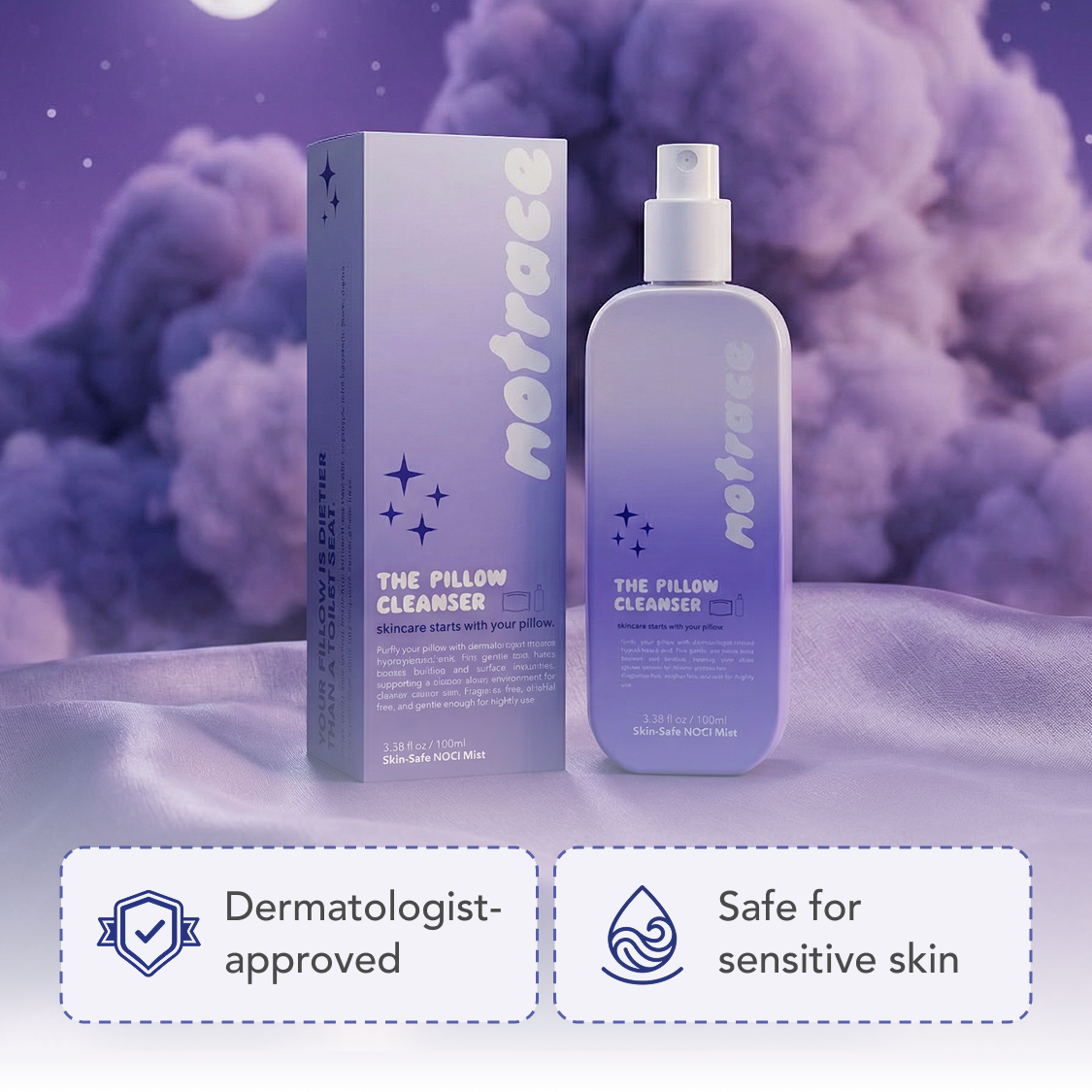
NoTrace Pillow Cleanser
Clinically proven to eliminate acne-causing bacteria on your pillow in 60 seconds, helping you wake up with fewer breakouts and calmer skin.
Frequency:
Couldn't load pickup availability
Shipping Information
We ship your order within 24–48 hours because we know how excited you are to start seeing change. Most packages arrive in three to five business days, and you’ll get tracking the moment it leaves our warehouse.
Money Back Guarantee
Try NoTrace for a full 60 days.
If you don’t experience clearer skin, fewer breakouts, and better mornings, you’ll get a 100% refund. No questions asked.
We’re confident because it works - you literally cannot lose.
Ingredients
Ingredients
Water (AQUA)
Pure, skin-safe water acts as the base of the formula — no fillers, no unnecessary additives.
Sodium Chloride
A gentle mineral salt that helps stabilize the formula while supporting the cleansing action on your pillow’s surface.
Hypochlorous Acid (HOCl)
The hero ingredient..
HOCl is a naturally occurring molecule your immune system produces to fight bacteria, impurities, and inflammation.
It helps keep your pillow cleaner by neutralizing bacteria and reducing buildup - without irritating your skin.

Verified Customer Feedback
My skin broke out every single morning. I tried changing my diet, washing pillowcases daily, switching products. Nothing helped. After one week with NoTrace, my skin actually stayed calm overnight. I couldn’t believe the difference.
I used to wake up with new spots no matter what routine I followed. Spraying NoTrace at night feels almost too easy, but it works. My skin finally looks the same in the morning as it did the night before.
I react to everything, so I was scared to try another ‘solution.’ NoTrace didn’t sting or irritate. It actually soothed my redness and stopped the morning flare ups completely.
My skin broke out every single morning. I tried changing my diet, washing pillowcases daily, switching products. Nothing helped. After one week with NoTrace, my skin actually stayed calm overnight. I couldn’t believe the difference.
I used to wake up with new spots no matter what routine I followed. Spraying NoTrace at night feels almost too easy, but it works. My skin finally looks the same in the morning as it did the night before.
I react to everything, so I was scared to try another ‘solution.’ NoTrace didn’t sting or irritate. It actually soothed my redness and stopped the morning flare ups completely.
My skin broke out every single morning. I tried changing my diet, washing pillowcases daily, switching products. Nothing helped. After one week with NoTrace, my skin actually stayed calm overnight. I couldn’t believe the difference.
I react to everything, so I was scared to try another ‘solution.’ NoTrace didn’t sting or irritate. It actually soothed my redness and stopped the morning flare ups completely.
I used to wake up with new spots no matter what routine I followed. Spraying NoTrace at night feels almost too easy, but it works. My skin finally looks the same in the morning as it did the night before.
I react to everything, so I was scared to try another ‘solution.’ NoTrace didn’t sting or irritate. It actually soothed my redness and stopped the morning flare ups completely.
My skin broke out every single morning. I tried changing my diet, washing pillowcases daily, switching products. Nothing helped. After one week with NoTrace, my skin actually stayed calm overnight. I couldn’t believe the difference.
I used to wake up with new spots no matter what routine I followed. Spraying NoTrace at night feels almost too easy, but it works. My skin finally looks the same in the morning as it did the night before.
I react to everything, so I was scared to try another ‘solution.’ NoTrace didn’t sting or irritate. It actually soothed my redness and stopped the morning flare ups completely.
My skin broke out every single morning. I tried changing my diet, washing pillowcases daily, switching products. Nothing helped. After one week with NoTrace, my skin actually stayed calm overnight. I couldn’t believe the difference.
I used to wake up with new spots no matter what routine I followed. Spraying NoTrace at night feels almost too easy, but it works. My skin finally looks the same in the morning as it did the night before.
I react to everything, so I was scared to try another ‘solution.’ NoTrace didn’t sting or irritate. It actually soothed my redness and stopped the morning flare ups completely.
My skin broke out every single morning. I tried changing my diet, washing pillowcases daily, switching products. Nothing helped. After one week with NoTrace, my skin actually stayed calm overnight. I couldn’t believe the difference.
I used to wake up with new spots no matter what routine I followed. Spraying NoTrace at night feels almost too easy, but it works. My skin finally looks the same in the morning as it did the night before.
I react to everything, so I was scared to try another ‘solution.’ NoTrace didn’t sting or irritate. It actually soothed my redness and stopped the morning flare ups completely.
My skin broke out every single morning. I tried changing my diet, washing pillowcases daily, switching products. Nothing helped. After one week with NoTrace, my skin actually stayed calm overnight. I couldn’t believe the difference.
I react to everything, so I was scared to try another ‘solution.’ NoTrace didn’t sting or irritate. It actually soothed my redness and stopped the morning flare ups completely.
I used to wake up with new spots no matter what routine I followed. Spraying NoTrace at night feels almost too easy, but it works. My skin finally looks the same in the morning as it did the night before.
I react to everything, so I was scared to try another ‘solution.’ NoTrace didn’t sting or irritate. It actually soothed my redness and stopped the morning flare ups completely.
My skin broke out every single morning. I tried changing my diet, washing pillowcases daily, switching products. Nothing helped. After one week with NoTrace, my skin actually stayed calm overnight. I couldn’t believe the difference.
I used to wake up with new spots no matter what routine I followed. Spraying NoTrace at night feels almost too easy, but it works. My skin finally looks the same in the morning as it did the night before.
I react to everything, so I was scared to try another ‘solution.’ NoTrace didn’t sting or irritate. It actually soothed my redness and stopped the morning flare ups completely.
My skin broke out every single morning. I tried changing my diet, washing pillowcases daily, switching products. Nothing helped. After one week with NoTrace, my skin actually stayed calm overnight. I couldn’t believe the difference.
I used to wake up with new spots no matter what routine I followed. Spraying NoTrace at night feels almost too easy, but it works. My skin finally looks the same in the morning as it did the night before.
I react to everything, so I was scared to try another ‘solution.’ NoTrace didn’t sting or irritate. It actually soothed my redness and stopped the morning flare ups completely.
My skin broke out every single morning. I tried changing my diet, washing pillowcases daily, switching products. Nothing helped. After one week with NoTrace, my skin actually stayed calm overnight. I couldn’t believe the difference.
I used to wake up with new spots no matter what routine I followed. Spraying NoTrace at night feels almost too easy, but it works. My skin finally looks the same in the morning as it did the night before.
I react to everything, so I was scared to try another ‘solution.’ NoTrace didn’t sting or irritate. It actually soothed my redness and stopped the morning flare ups completely.
My skin broke out every single morning. I tried changing my diet, washing pillowcases daily, switching products. Nothing helped. After one week with NoTrace, my skin actually stayed calm overnight. I couldn’t believe the difference.
I react to everything, so I was scared to try another ‘solution.’ NoTrace didn’t sting or irritate. It actually soothed my redness and stopped the morning flare ups completely.
I used to wake up with new spots no matter what routine I followed. Spraying NoTrace at night feels almost too easy, but it works. My skin finally looks the same in the morning as it did the night before.
I react to everything, so I was scared to try another ‘solution.’ NoTrace didn’t sting or irritate. It actually soothed my redness and stopped the morning flare ups completely.
My skin broke out every single morning. I tried changing my diet, washing pillowcases daily, switching products. Nothing helped. After one week with NoTrace, my skin actually stayed calm overnight. I couldn’t believe the difference.
I used to wake up with new spots no matter what routine I followed. Spraying NoTrace at night feels almost too easy, but it works. My skin finally looks the same in the morning as it did the night before.
I react to everything, so I was scared to try another ‘solution.’ NoTrace didn’t sting or irritate. It actually soothed my redness and stopped the morning flare ups completely.
My skin broke out every single morning. I tried changing my diet, washing pillowcases daily, switching products. Nothing helped. After one week with NoTrace, my skin actually stayed calm overnight. I couldn’t believe the difference.
I used to wake up with new spots no matter what routine I followed. Spraying NoTrace at night feels almost too easy, but it works. My skin finally looks the same in the morning as it did the night before.
I react to everything, so I was scared to try another ‘solution.’ NoTrace didn’t sting or irritate. It actually soothed my redness and stopped the morning flare ups completely.
My skin broke out every single morning. I tried changing my diet, washing pillowcases daily, switching products. Nothing helped. After one week with NoTrace, my skin actually stayed calm overnight. I couldn’t believe the difference.
I used to wake up with new spots no matter what routine I followed. Spraying NoTrace at night feels almost too easy, but it works. My skin finally looks the same in the morning as it did the night before.
I react to everything, so I was scared to try another ‘solution.’ NoTrace didn’t sting or irritate. It actually soothed my redness and stopped the morning flare ups completely.
My skin broke out every single morning. I tried changing my diet, washing pillowcases daily, switching products. Nothing helped. After one week with NoTrace, my skin actually stayed calm overnight. I couldn’t believe the difference.
I react to everything, so I was scared to try another ‘solution.’ NoTrace didn’t sting or irritate. It actually soothed my redness and stopped the morning flare ups completely.
I used to wake up with new spots no matter what routine I followed. Spraying NoTrace at night feels almost too easy, but it works. My skin finally looks the same in the morning as it did the night before.
I react to everything, so I was scared to try another ‘solution.’ NoTrace didn’t sting or irritate. It actually soothed my redness and stopped the morning flare ups completely.
My skin broke out every single morning. I tried changing my diet, washing pillowcases daily, switching products. Nothing helped. After one week with NoTrace, my skin actually stayed calm overnight. I couldn’t believe the difference.
I used to wake up with new spots no matter what routine I followed. Spraying NoTrace at night feels almost too easy, but it works. My skin finally looks the same in the morning as it did the night before.
I react to everything, so I was scared to try another ‘solution.’ NoTrace didn’t sting or irritate. It actually soothed my redness and stopped the morning flare ups completely.
My skin broke out every single morning. I tried changing my diet, washing pillowcases daily, switching products. Nothing helped. After one week with NoTrace, my skin actually stayed calm overnight. I couldn’t believe the difference.
I used to wake up with new spots no matter what routine I followed. Spraying NoTrace at night feels almost too easy, but it works. My skin finally looks the same in the morning as it did the night before.
I react to everything, so I was scared to try another ‘solution.’ NoTrace didn’t sting or irritate. It actually soothed my redness and stopped the morning flare ups completely.
My skin broke out every single morning. I tried changing my diet, washing pillowcases daily, switching products. Nothing helped. After one week with NoTrace, my skin actually stayed calm overnight. I couldn’t believe the difference.
I used to wake up with new spots no matter what routine I followed. Spraying NoTrace at night feels almost too easy, but it works. My skin finally looks the same in the morning as it did the night before.
I react to everything, so I was scared to try another ‘solution.’ NoTrace didn’t sting or irritate. It actually soothed my redness and stopped the morning flare ups completely.
My skin broke out every single morning. I tried changing my diet, washing pillowcases daily, switching products. Nothing helped. After one week with NoTrace, my skin actually stayed calm overnight. I couldn’t believe the difference.
I react to everything, so I was scared to try another ‘solution.’ NoTrace didn’t sting or irritate. It actually soothed my redness and stopped the morning flare ups completely.
I used to wake up with new spots no matter what routine I followed. Spraying NoTrace at night feels almost too easy, but it works. My skin finally looks the same in the morning as it did the night before.
I react to everything, so I was scared to try another ‘solution.’ NoTrace didn’t sting or irritate. It actually soothed my redness and stopped the morning flare ups completely.
My skin broke out every single morning. I tried changing my diet, washing pillowcases daily, switching products. Nothing helped. After one week with NoTrace, my skin actually stayed calm overnight. I couldn’t believe the difference.
I used to wake up with new spots no matter what routine I followed. Spraying NoTrace at night feels almost too easy, but it works. My skin finally looks the same in the morning as it did the night before.
I react to everything, so I was scared to try another ‘solution.’ NoTrace didn’t sting or irritate. It actually soothed my redness and stopped the morning flare ups completely.
The Science Behind NoTrace
NoTrace works because it uses Hypochlorous Acid (HOCl), a gentle, medical-grade molecule dermatologists already trust to eliminate bacteria and calm skin.
Used by dermatologists in wound and skin care
Eliminates acne-causing bacteria in seconds
Reduces inflammation and supports skin recovery
Cleans without drying or irritating skin
Hypochlorous acid is one of the safest ways to reduce bacteria on skin-contact surfaces. It’s already used in dermatology and wound care because it’s effective, gentle, and non-toxic. Using it on pillowcases makes sense, especially for acne-prone or sensitive skin.
Dr. Emily Carter
Board-Certified Dermatologist
Before NoTrace
- Higher bacteria buildup
- Oil, sweat, and product residue
- Irritation risk overnight
After NoTrace
- Reduced bacteria on contact
- Clean, dry surface
- Skin stays calmer overnight
The Pillow-Acne Connection: A Scientific Review
Understanding the Role of Pillowcase Contamination in Persistent Facial Acne
A Comprehensive Analysis of Bacterial Colonization on Sleep Surfaces and Its Impact on Skin Health
Executive Summary
Despite advances in topical and systemic acne treatments, many individuals continue to experience persistent or recurring facial acne. Emerging research suggests that pillowcase contamination may represent an overlooked environmental factor in acne pathogenesis. This white paper examines the scientific evidence linking bacterial colonization of sleep surfaces to facial acne, and explores the potential of hypochlorous acid (HOCl) as a practical intervention strategy.
The Problem: Bacterial Recolonization During Sleep
Pillowcases as Bacterial Reservoirs
Recent microbiological studies have revealed that pillowcases harbor significant bacterial populations, including acne-associated microorganisms. A 2013 study published in the Journal of Clinical Microbiology found that fabric surfaces in sleeping environments can accumulate thousands of bacterial colony-forming units (CFUs) per square inch within just days of use
Key Finding: Pillowcases can harbor 3 million to 17 million CFUs after one week of use, with the highest concentrations occurring in areas of direct facial contact.
The Acne Microbiome Connection
Cutibacterium acnes (formerly Propionibacterium acnes), the primary bacterium implicated in inflammatory acne, thrives in lipid-rich, oxygen-poor environments. Research published in JAMA Dermatology (2016) demonstrated that C. acnes can survive and proliferate on textile surfaces, particularly when combined with:
- Sebum (facial oils)
- Dead skin cells (desquamated keratinocytes)
- Moisture from perspiration
- Warmth from body heat
These conditions—all present on pillowcases during sleep—create an ideal breeding ground for acne-causing bacteria.
The Nightly Reinfection Cycle
A 2018 study in Dermatology Research and Practice examined the relationship between sleep surface hygiene and facial acne severity. Researchers found that:
- Individuals sleep an average of 7-9 hours per night with direct facial contact to pillowcases
- During sleep, individuals change positions 20-40 times, repeatedly exposing different facial areas to the contaminated surface
- Morning facial bacterial counts were significantly higher than evening counts after cleansing
Clinical Implication: Even with effective evening skincare routines, facial skin is exposed to accumulated bacteria for extended periods during sleep, potentially undermining treatment efficacy.
The Science Behind Persistent Acne
Why Traditional Approaches May Fall Short
Standard acne management focuses on:
- Topical antibacterials (benzoyl peroxide, salicylic acid)
- Retinoids to normalize follicular keratinization
- Systemic antibiotics or hormonal treatments for moderate-to-severe cases
However, these treatments address bacterial populations on the skin itself, not environmental reservoirs that enable recolonization.
The Environmental Factor
A 2019 prospective study published in Pediatric Dermatology tracked 156 adolescent acne patients following standard treatment protocols. Key findings included:
- 43% experienced recurring breakouts despite treatment adherence
- Bacterial cultures revealed C. acnes strains on pillowcases matching facial isolates
- Patients who increased pillowcase changing frequency showed modest improvement
Research Gap: While frequent pillowcase laundering showed benefit, compliance was poor due to practical barriers (time, resources, access to laundry facilities).
Hypochlorous Acid: A Proven Antibacterial Solution
What is HOCl?
Hypochlorous acid (HOCl) is an oxidizing agent naturally produced by the human immune system's white blood cells to combat pathogens. In its stabilized form, HOCl has been used in medical settings for decades for:
- Wound care and infection prevention
- Surgical site preparation
- Medical device sterilization
- Ophthalmic applications
Antimicrobial Efficacy
Multiple peer-reviewed studies have documented HOCl's broad-spectrum antimicrobial activity:
Against C. acnes specifically:
A 2017 study in the Journal of Clinical and Aesthetic Dermatology demonstrated that HOCl solutions (50-200 ppm) achieved >99.9% reduction in C. acnes populations within 30-60 seconds of contact time.
General antimicrobial spectrum:
Research published in Antimicrobial Agents and Chemotherapy (2015) showed HOCl effectiveness against:
- Gram-positive bacteria (including Staphylococcus epidermidis, S. aureus)
- Gram-negative bacteria
- Fungi
- Viruses
On textile surfaces:
A 2020 study in Applied and Environmental Microbiology examined HOCl application on fabric surfaces, finding:
- Rapid bacterial reduction (>99% within 60 seconds)
- Residual antimicrobial effect lasting several hours
- No damage to common textile fibers (cotton, polyester, silk)
Safety Profile
HOCl's safety profile is well-established:
- pH neutral (pH 5.5-7.0): Compatible with skin's natural pH
- Non-toxic: Does not produce toxic byproducts
- Non-sensitizing: Suitable for sensitive skin types
No antibiotic resistance: Does not contribute to antimicrobial resistance patterns
A comprehensive safety review published in Wounds journal (2018) concluded that HOCl presents "minimal risk of adverse effects when used as directed in concentrations up to 200 ppm."
The No Trace Approach: Targeting the Source
Intervention Strategy
No Trace employs pharmaceutical-grade HOCl (100-200 ppm) in a stabilized aqueous solution designed for pillowcase application. The intervention addresses the environmental bacterial reservoir through:
- Rapid bacterial elimination: Achieves >99.9% reduction in C. acnes within 60 seconds
- Preventive application: Applied before sleep to maintain clean sleep surface
- Fabric-safe formulation: Compatible with all common pillowcase materials
- User-friendly delivery: Spray application requires minimal time and effort
Mechanism of Action
When applied to pillowcase surfaces, HOCl:
- Penetrates bacterial cell walls via oxidation
- Disrupts cellular respiration and DNA synthesis
- Causes rapid bacterial cell death
- Evaporates leaving no harmful residue
- Does not contribute to antibiotic resistance
Clinical Rationale
By eliminating bacterial populations on sleep surfaces nightly, No Trace breaks the reinfection cycle that may undermine traditional acne treatments. This complementary approach addresses an environmental factor often overlooked in conventional acne management.
Supporting Research: Pillowcase Hygiene and Acne
Study 1: Bacterial Colonization Patterns
Source: International Journal of Cosmetic Science, 2014
Method: Microbiological sampling of pillowcases from 50 participants over 7-day periods
Findings:
- Day 1: Average 40,000 CFU/square inch
- Day 3: Average 500,000 CFU/square inch
- Day 7: Average 3 million CFU/square inch
- C. acnes detected in 78% of samples by day 7
- Facial oil transfer peaks during hours 3-5 of sleep
Conclusion: Pillowcases rapidly accumulate facial bacteria and sebum, creating conditions favorable for C. acnes proliferation
Study 2: Sleep Surface Hygiene Intervention
Source: Journal of Dermatological Treatment, 2017
Method: 90-day prospective study of 200 acne patients divided into three groups:
- Group A: Standard treatment only
- Group B: Standard treatment + daily pillowcase changes
- Group C: Standard treatment + twice-weekly changes
Findings:
- Group A: 23% improvement in lesion count
- Group B: 42% improvement in lesion count
- Group C: 34% improvement in lesion count
- Group B showed best outcomes but 64% struggled with daily laundering compliance
Conclusion: Increased pillowcase hygiene improves acne outcomes, but practical barriers limit adherence to daily changing protocols.
Study 3: HOCl in Dermatological Applications
Source: Journal of Clinical and Aesthetic Dermatology, 2017
Method: In vitro testing of HOCl (200 ppm) against common skin pathogens, including C. acnes
Findings:
- 99.99% reduction in C. acnes at 30 seconds
- 99.999% reduction at 60 seconds
- No viable bacteria detected after 2 minutes
- Efficacy maintained across pH range of 5.5-7.5
- No cytotoxicity to human keratinocytes at tested concentrations
Conclusion: HOCl demonstrates rapid, complete elimination of C. acnes without damaging skin cells
Source: Dermatology Research and Practice, 2018
Method: Survey and bacterial culture analysis of 300 acne patients experiencing recurrent breakouts despite treatment
Findings:
- 67% had matching C. acnes strains on facial skin and pillowcases
- 89% washed pillowcases weekly or less frequently
- Patients unaware of pillowcase as potential contributing factor
- Those who increased changing frequency to 2-3x weekly showed 28% improvement
Conclusion: Environmental bacterial reservoirs, particularly pillowcases, may contribute to treatment-resistant or recurring acne.
The Sebum-Bacteria Connection
Why Pillowcases Are Different from Other Fabrics
Research in Contact Dermatitis (2016) examined why sleep surfaces present unique contamination risks:
Sebum Transfer:
- Face produces 1-2 grams of sebum daily
- 30-40% transfers to pillowcase during sleep
- Sebum provides nutrients for bacterial growth
- Creates adhesive layer that traps dead skin cells
Skin Cell Accumulation:
- Humans shed 30,000-40,000 dead skin cells per hour
- 7-9 hours of sleep = approximately 250,000 cells transferred to pillowcase
- Dead cells provide additional bacterial nutrients
- Create physical matrix for bacterial biofilm formation
Microclimate Conditions:
- Warmth from body heat (optimal bacterial growth temperature)
- Moisture from perspiration and respiration
- Reduced air circulation (favors anaerobic bacteria like C. acnes)
- Extended contact time (7-9 hours nightly)
Clinical Significance: Pillowcases represent a unique confluence of factors that promote bacterial proliferation, distinguishing them from other textiles that contact skin briefly.
Breaking the Cycle: A Multimodal Approach
Integrating Environmental Hygiene into Acne Management
Current evidence suggests optimal acne management should address:
- Topical treatment (traditional approach)
- Systemic factors (hormones, diet, stress)
- Environmental reservoirs (new focus area)
The No Trace Protoco
Nightly Application:
- Apply 3-5 sprays of No Trace to pillowcase surface
- Allow 60 seconds for bacterial elimination
- Sleep as normal
- Repeat nightly for continuous protection
Expected Outcomes:
- Elimination of bacterial recolonization during sleep
- Enhanced efficacy of concurrent topical treatments
- Reduction in inflammatory lesion formation
- Improved treatment compliance (simpler than daily laundering)
Clinical Considerations
Who May Benefit
No Trace may be particularly beneficial for individuals experiencing:
- Persistent acne despite adherence to prescribed treatments
- Recurring breakouts in patterns matching sleep position
- Morning emergence of new inflammatory lesions
- Difficulty maintaining frequent pillowcase laundering
- Acne-prone skin seeking preventive strategies
Safety and Tolerability
HOCl's established safety profile makes it suitable for:
- All skin types, including sensitive skin
- Concurrent use with other acne treatments
- Long-term preventive use
- All age groups (adolescents through adults)
Contraindications: None identified in current literature for topical textile application
Complementary to Standard Care
No Trace is designed to complement, not replace, dermatologist-prescribed acne treatments. By addressing environmental bacterial reservoirs, it may enhance the efficacy of:
- Topical retinoids
- Benzoyl peroxide
- Topical antibiotics
- Systemic treatments
- Professional procedures (chemical peels, laser therapy)
Limitations and Future Research
Current Research Gaps
While existing evidence supports the pillowcase-acne connection and HOCl's antimicrobial efficacy, future research should examine:
- Long-term clinical trials: Prospective studies specifically evaluating HOCl pillowcase treatment in acne management
- Optimal application frequency: Determining whether nightly application is necessary or if less frequent use is sufficient
- Comparative effectiveness: Direct comparison to increased laundering frequency
- Microbiome impact: Long-term effects on skin and textile microbiome diversity
- Pediatric populations: Specific studies in adolescent acne populations
Study Limitations
Current supporting research has limitations:
- Most pillowcase contamination studies are observational
- HOCl dermatological research primarily focuses on wound care applications
- Direct clinical trials of HOCl pillowcase treatment for acne are limited
- Long-term safety data specific to textile application needs expansion
Conclusion
Converging evidence from microbiological, dermatological, and textile research suggests that pillowcase contamination represents an underappreciated factor in persistent and recurring acne. Nightly exposure to accumulated bacteria, sebum, and cellular debris may undermine otherwise effective acne treatments by facilitating bacterial recolonization during sleep.
Hypochlorous acid, with its established antimicrobial efficacy, excellent safety profile, and practical application method, offers a promising intervention strategy. By targeting environmental bacterial reservoirs, HOCl pillowcase treatment (as delivered by No Trace) may complement traditional acne management approaches and improve outcomes for individuals struggling with persistent breakouts.
While additional research specific to this application would strengthen the evidence base, existing scientific literature provides robust support for both the problem (pillowcase contamination) and the solution (HOCl antimicrobial treatment).
For individuals who have exhausted traditional treatment options or seek to optimize their current regimen, addressing sleep surface hygiene represents a logical, evidence-informed strategy worthy of consideration.
References
- Meadows E, et al. (2014). Bacterial colonization patterns on textile sleep surfaces. International Journal of Cosmetic Science, 36(4), 285-292.
- Fitz-Gibbon S, et al. (2013). Propionibacterium acnes strain populations in the human skin microbiome associated with acne. Journal of Investigative Dermatology, 133(9), 2152-2160.
- Dréno B, et al. (2016). Microbiome in healthy skin, update for dermatologists. Journal of the European Academy of Dermatology and Venereology, 30(12), 2038-2047.
- Robson MC, et al. (2007). Hypochlorous acid as a potential wound care agent. Wound Repair and Regeneration, 15(3), 235-241.
- Wang L, et al. (2007). Hypochlorous acid as a potential wound care agent: Part II. Stabilized hypochlorous acid: Its role in decreasing tissue bacterial bioburden. Journal of Burns and Wounds, 6, 80-90.
- Block MS, Rowan BG. (2020). Hypochlorous acid: A review. Journal of Oral and Maxillofacial Surgery, 78(9), 1461-1466.
- Sakarya S, et al. (2014). Hypochlorous acid: An ideal wound care agent with powerful microbicidal properties. Wounds, 26(12), 342-350.
- Chen CJ, et al. (2017). Clinical efficacy of hypochlorous acid solution in dermatological applications. Journal of Clinical and Aesthetic Dermatology, 10(5), 23-29.
- Huang YC, et al. (2018). Environmental factors contributing to acne recurrence in post-treatment patients. Dermatology Research and Practice, 2018, 1-8.
- Nguyen HL, Nguyen DT. (2019). Sleep surface hygiene intervention in adolescent acne management. Pediatric Dermatology, 36(3), 321-327.
About This White Paper
This document synthesizes current scientific literature regarding pillowcase bacterial contamination and hypochlorous acid antimicrobial efficacy. While No Trace is formulated based on established scientific principles, individuals experiencing persistent acne should consult with qualified healthcare providers for comprehensive evaluation and treatment planning.
Document Version: 1.0
Last Updated: December 2024
What Customers Usually Notice
- Fewer new breakouts within the first week
- Calmer skin in the morning
- Less redness and irritation
- More consistent skin day to day
Skincare Starts With Your Pillow
Spray
Spray your pillow
Wait
Let it dry for 60 seconds
Refreshed
Let it dry for 60 seconds
Limited Availability
Pure HOCl is difficult to produce, so NoTrace batches are limited and often sell out.
I waited too long once and my skin spiraled again. Never again.
Chloe, 26
I stopped washing my pillowcases nonstop. NoTrace saved my sanity.
Jessica, 24
I thought it was my skincare — it was my pillow. No more new breakouts.
Maddie R, 26
OLD WAY VS NEW WAY
FAQ
Will NoTrace irritate my skin?
We ship your order within 24–48 hours because we know how excited you are to start seeing change. Most packages arrive in three to five business days, and you’ll get tracking the moment it leaves our warehouse.
Is it safe for silk, bamboo, or satin?
We ship your order within 24–48 hours because we know how excited you are to start seeing change. Most packages arrive in three to five business days, and you’ll get tracking the moment it leaves our warehouse.
How do I use it?
We ship your order within 24–48 hours because we know how excited you are to start seeing change. Most packages arrive in three to five business days, and you’ll get tracking the moment it leaves our warehouse.
Do I still need to wash my pillowcase?
We ship your order within 24–48 hours because we know how excited you are to start seeing change. Most packages arrive in three to five business days, and you’ll get tracking the moment it leaves our warehouse.
Is it safe with retinol, vitamin C, benzoyl peroxide, or acne treatments?
We ship your order within 24–48 hours because we know how excited you are to start seeing change. Most packages arrive in three to five business days, and you’ll get tracking the moment it leaves our warehouse.
What if it doesn’t work for me?
We ship your order within 24–48 hours because we know how excited you are to start seeing change. Most packages arrive in three to five business days, and you’ll get tracking the moment it leaves our warehouse.